Build agentic apps.
Compose them. Ship them.
Handover is a platform for assembling agentic applications from composable parts: MCP resources, small-LLM skills, frontier agents, lifecycle hooks, scheduled quests. Multi-tenant, your data and credentials stay yours. Currently in active development.
14,000,605 possible apps.
Compose any of them in three layers.
In Infinity War, Doctor Strange searched 14,000,605 futures for the one where the Avengers won. Building an agentic app is the same problem at smaller scale — a search through a space of compositions. Three layers, named and reusable; the lower layers don't know about the higher, so you can rewire freely as you find the path that ships.
Resource
An MCP server you mount — stdio command or SSE endpoint. Tools are auto-discovered and made callable. This is where raw capability lives.
filesystem · gmail · slack · …Skill
A small-LLM agent with a system prompt and a set of bound resources. From the outside it's a single tool with a typed interface — its inner agent loop is hidden.
research_topic(query, depth)Agent
A frontier-model agent that composes skills and direct resources to handle the task. Top-level — runs in chat sessions or quest runs.
Claude · GPT · Gemini · …Hidden complexity, exposed contracts. A skill that uses three resources still presents one tool. An agent that pulls from a dozen skills still talks like a single chatbot. Each layer is a black box to the layers above it — composition without leak.
Hundreds. Thousands. Tens of thousands.
Days, not months. Not years.
Domain experts who know their problem can compose agentic apps on Handover in an afternoon. Resources reuse across apps, skills compose into agents, hooks chain, quests schedule — when the parts are this composable, building one is mostly choosing. What used to be a six-month roadmap becomes a week’s work, and the next one is even faster.
Apps bundle everything
one product needs.
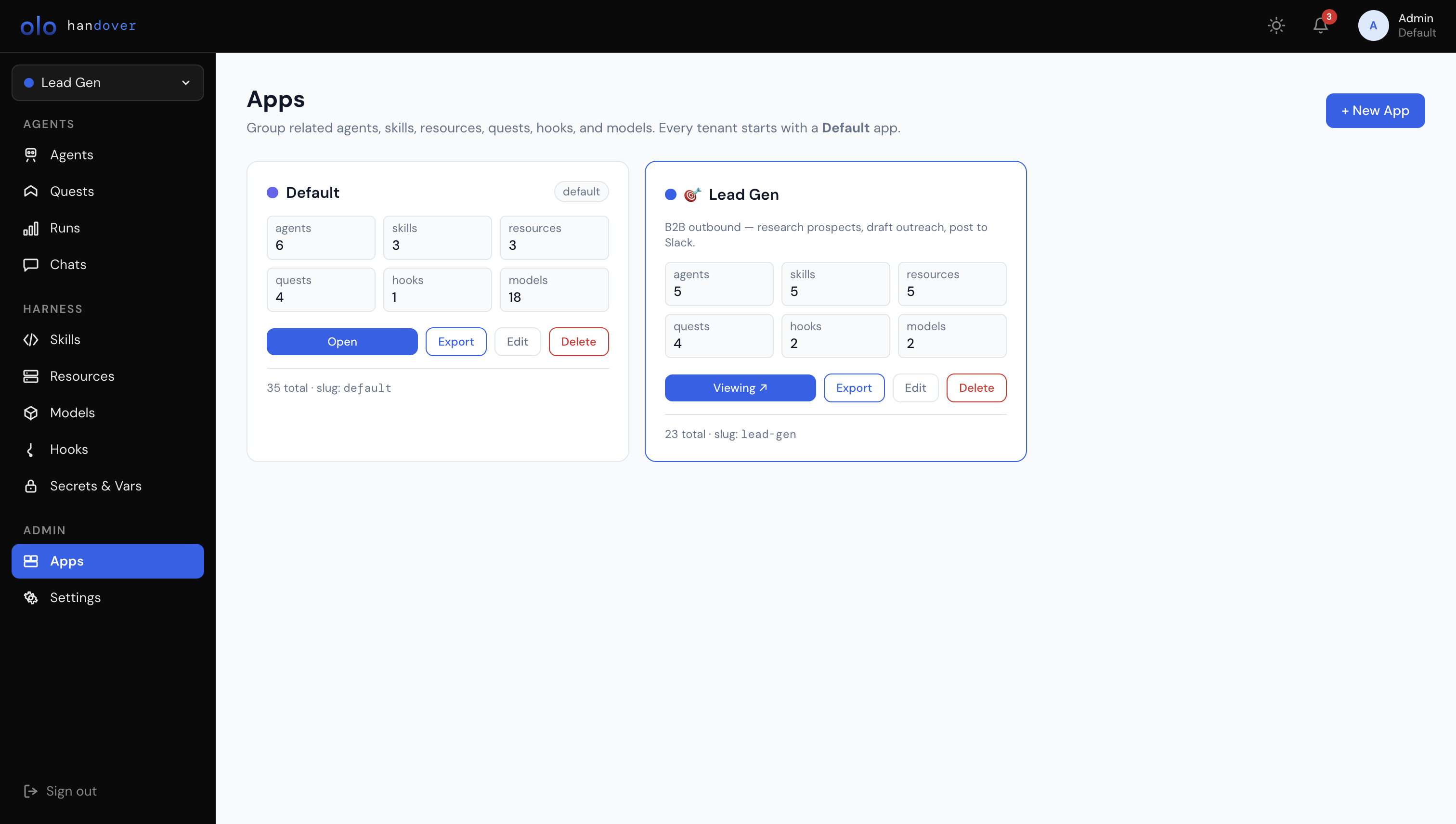
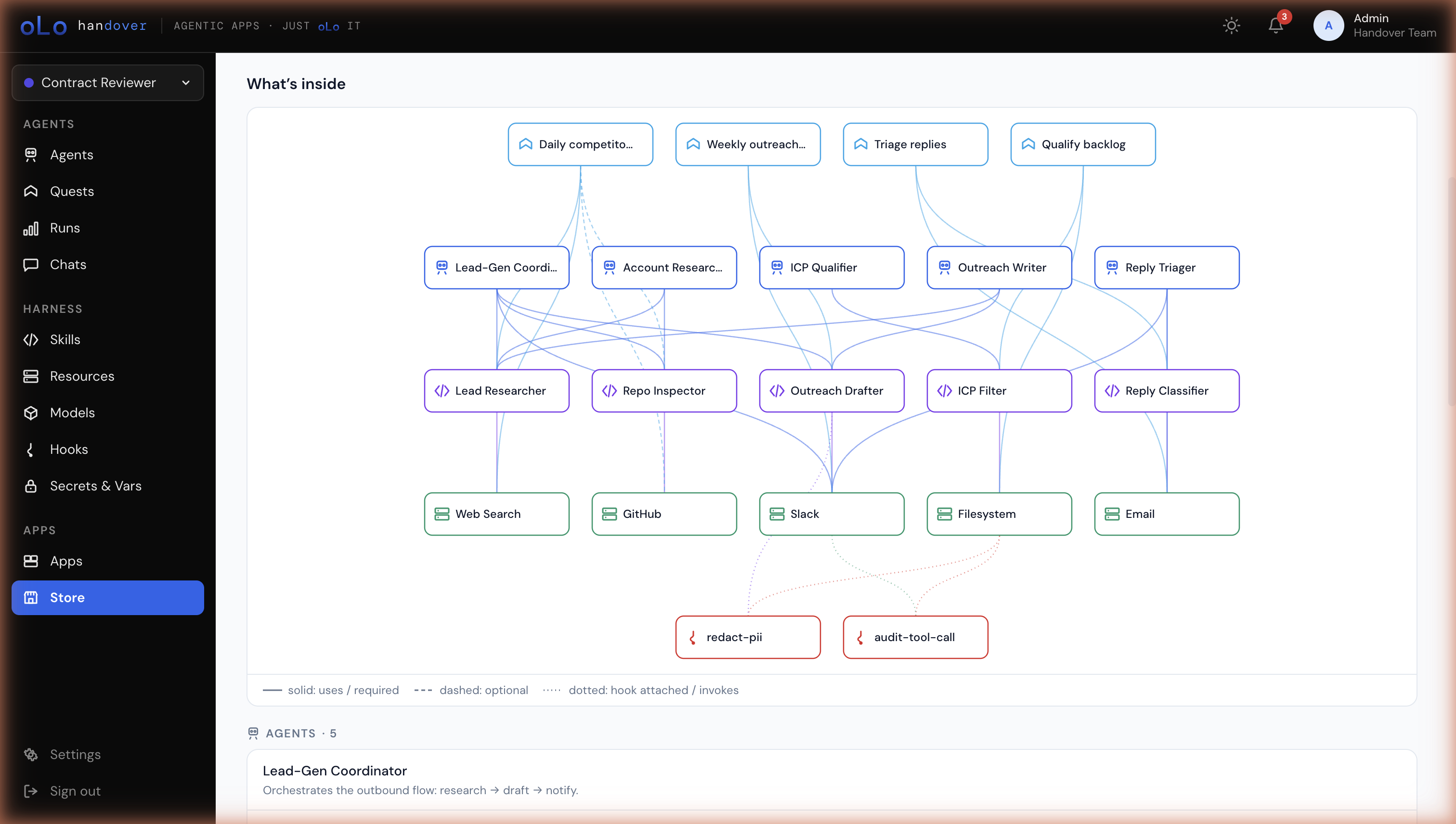
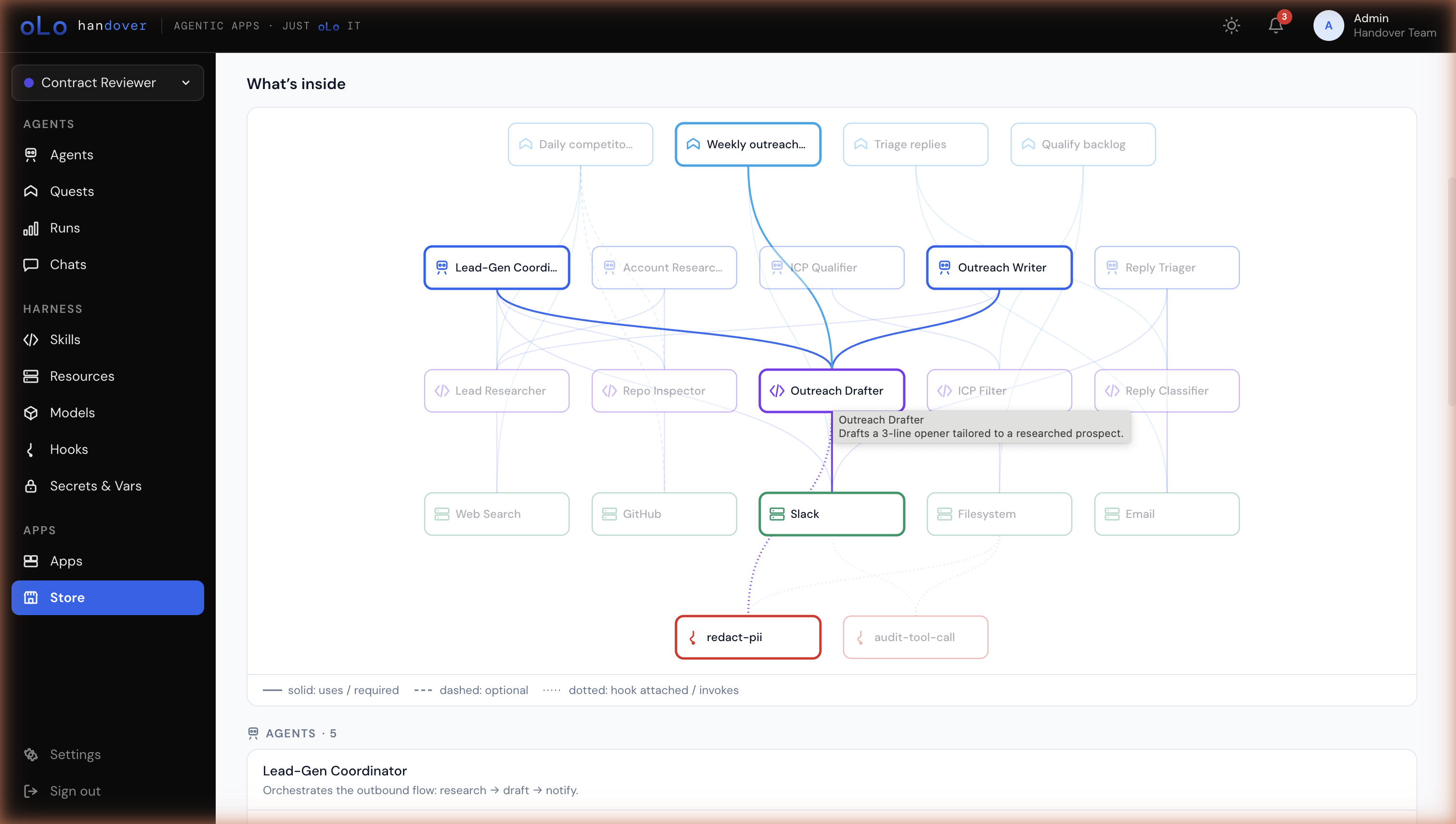
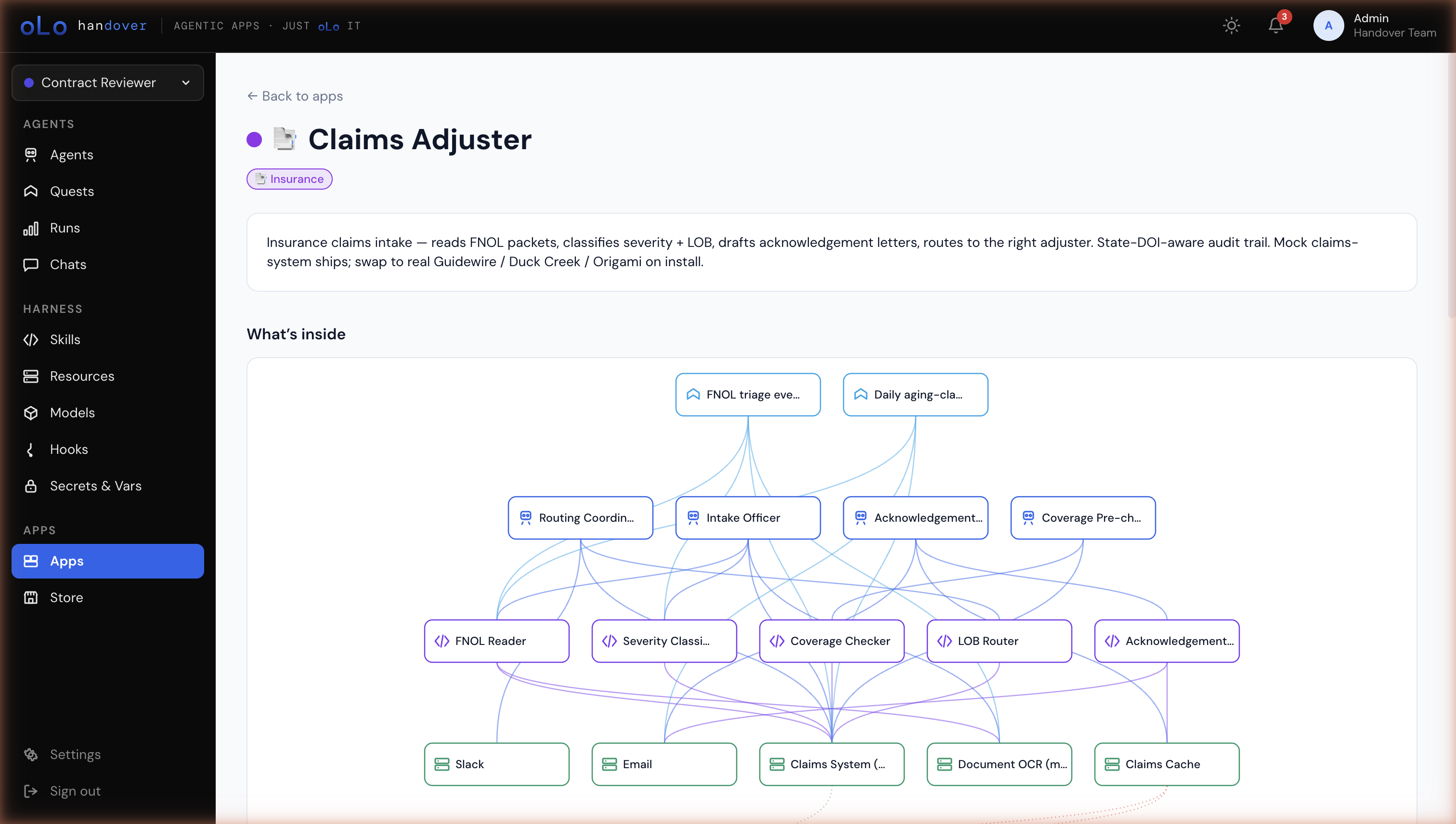
An App is a tenant-scoped project: a coherent bundle of agents, skills, resources, hooks, scheduled quests, secrets, and variables that together make one agentic application. Browse, edit, export — and view its full composition as a relational graph derived from the bundle's own reference fields.
Many-to-many composition
A resource lives in your tenant once and joins as many apps as you want. No duplication. The Default app is the shared pool; project apps inherit from it via fallback.
Quests with cron schedules
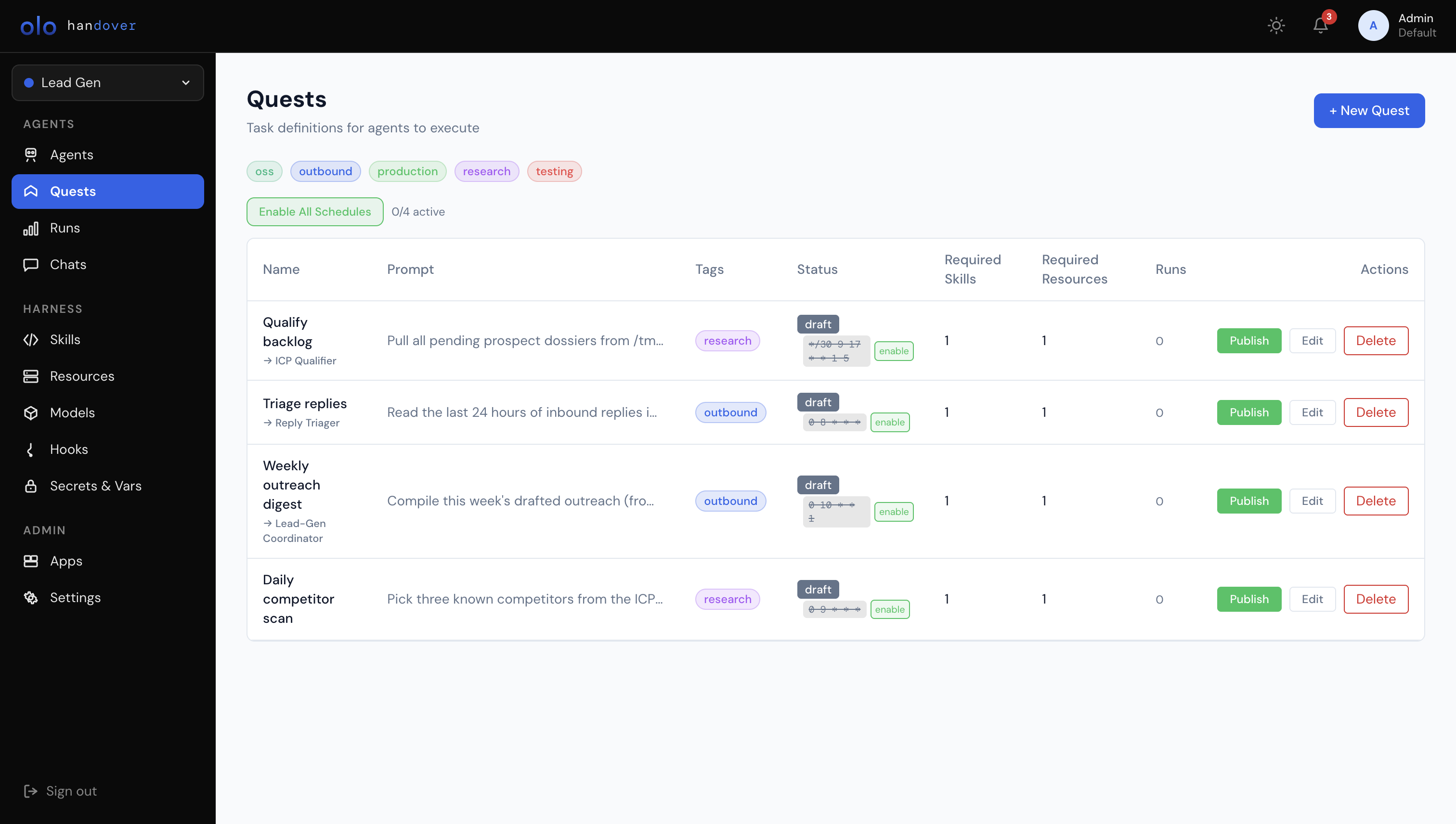
A quest is a task definition: prompt, capability requirements, optional cron. The matcher routes it to a capable agent — or pin it to a specific one with assigned_agent_id.
Chat sessions out of the box
Every agent gets a chat surface. Sessions are durable — close the tab, come back, the conversation picks up exactly where it left off.
Hooks at every boundary
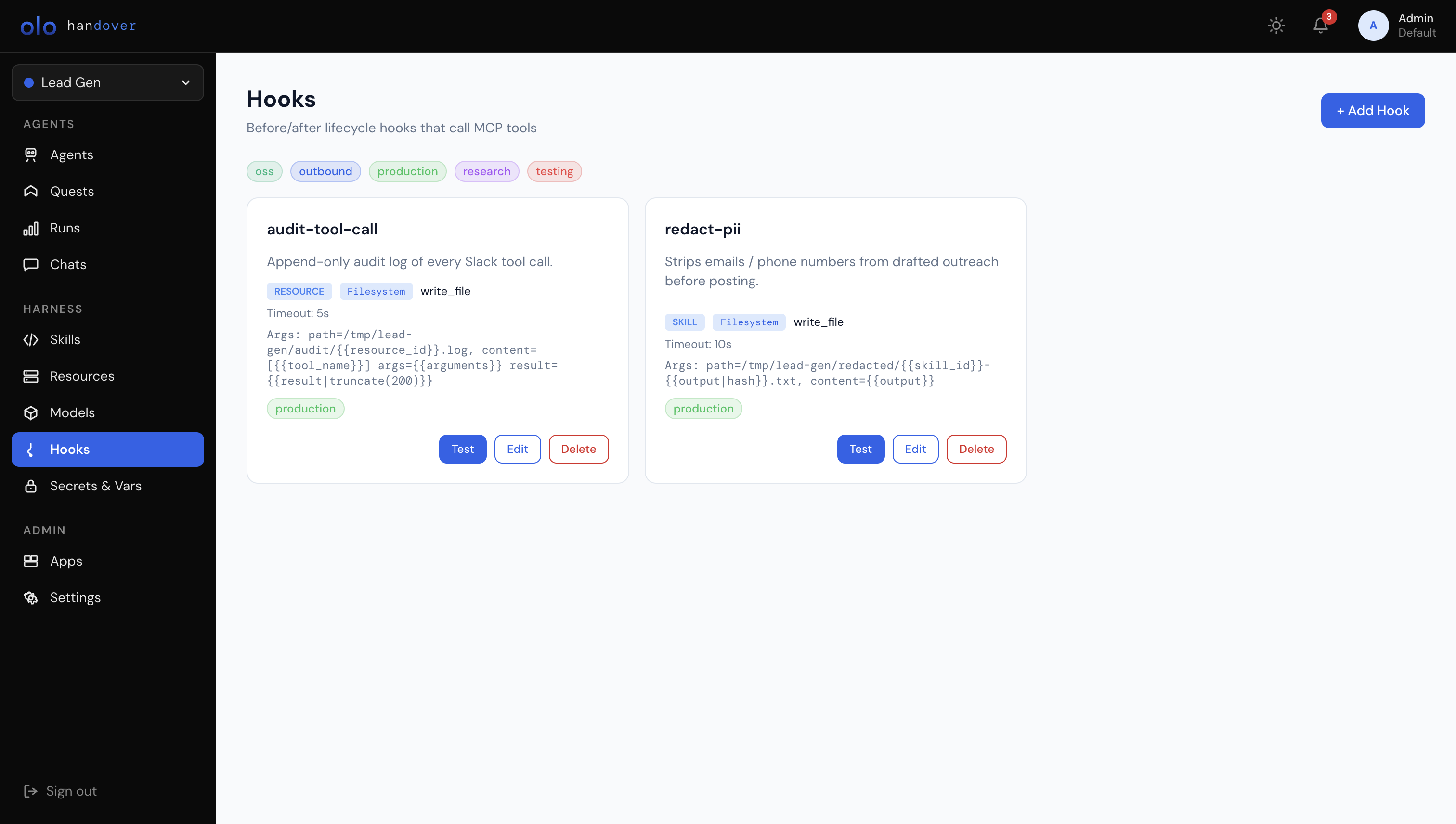
Wrap any entity with before/after hooks: redact PII, fetch a token, write an audit row, abort on guardrail breach. Hooks chain results into a shared context for downstream stages.
One coherent platform.
Every surface you need.
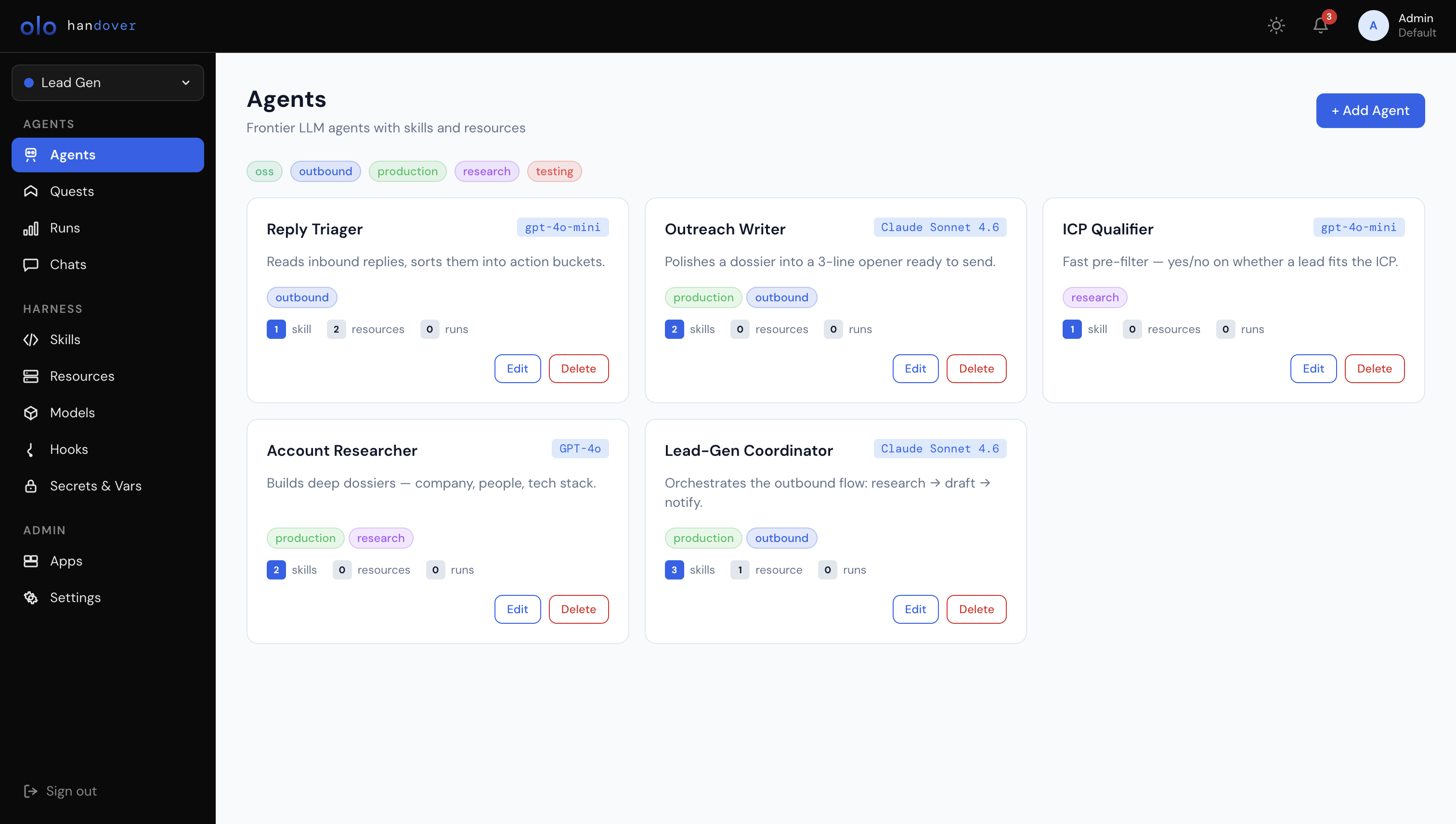
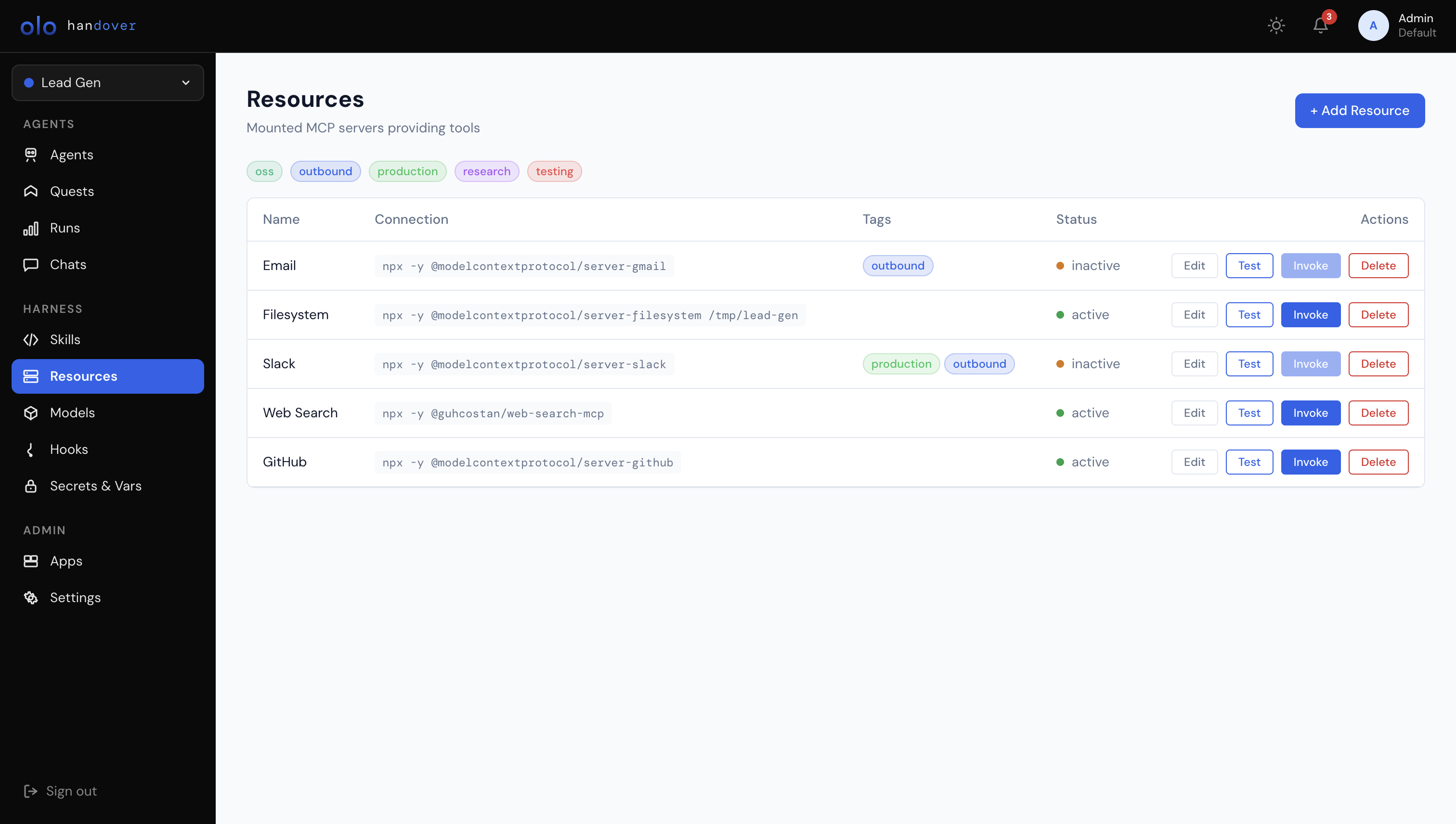
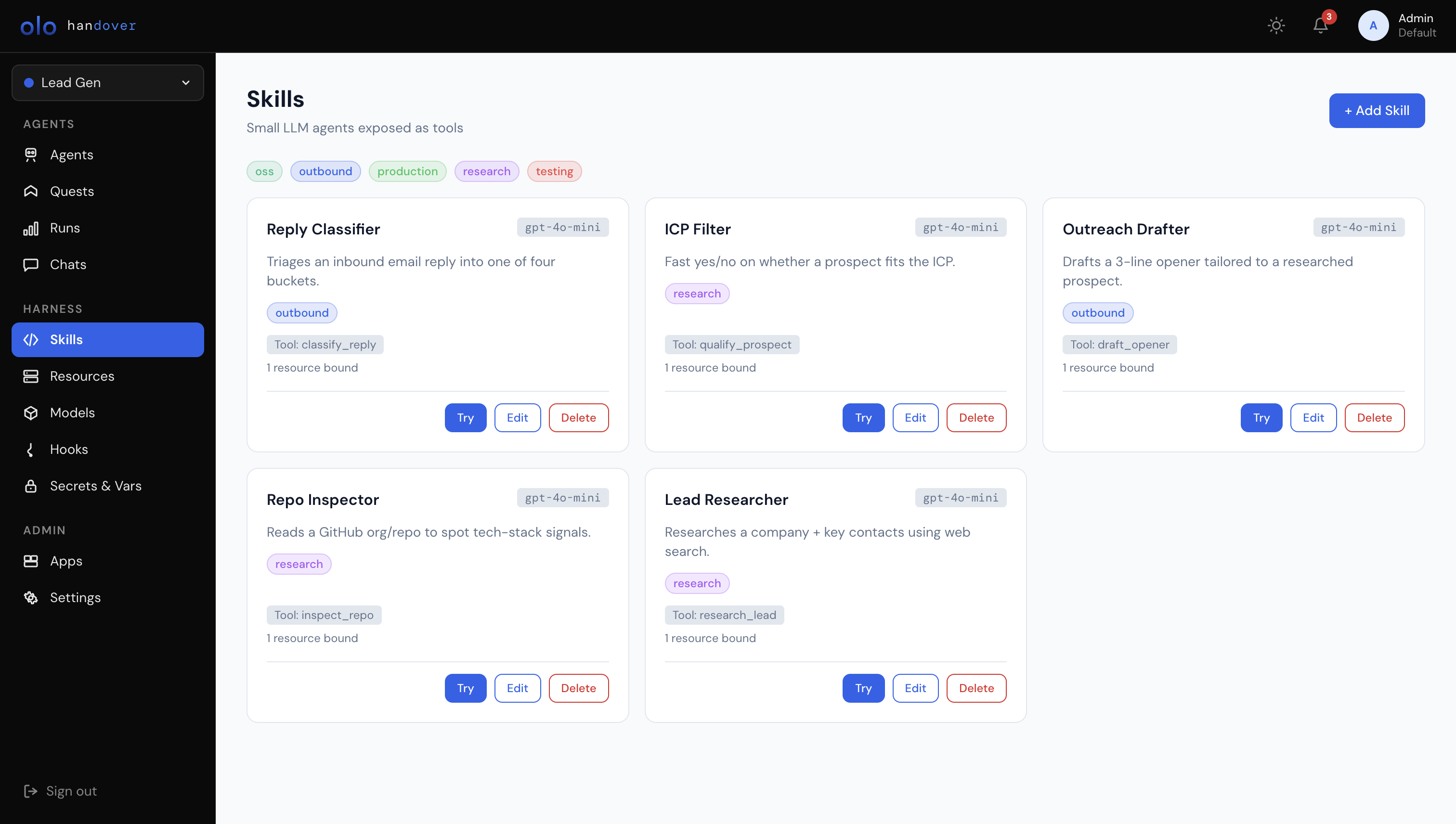
A tour of the Lead Gen example app — five agents, five skills, five MCP resources, four scheduled quests, two custom models, two hooks. Everything one outbound product needs, all in one place.
${{ }} chips show resolved references.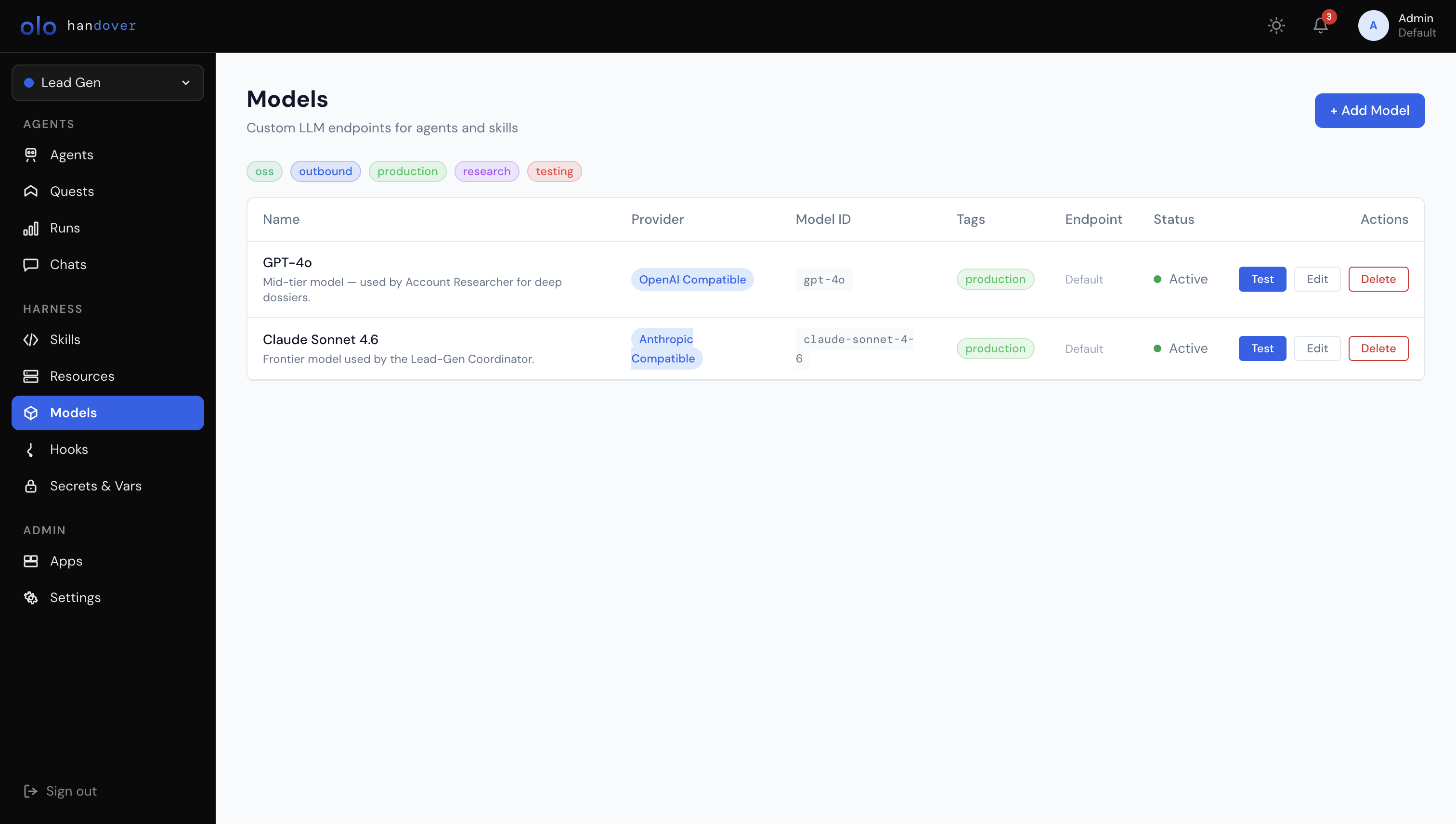
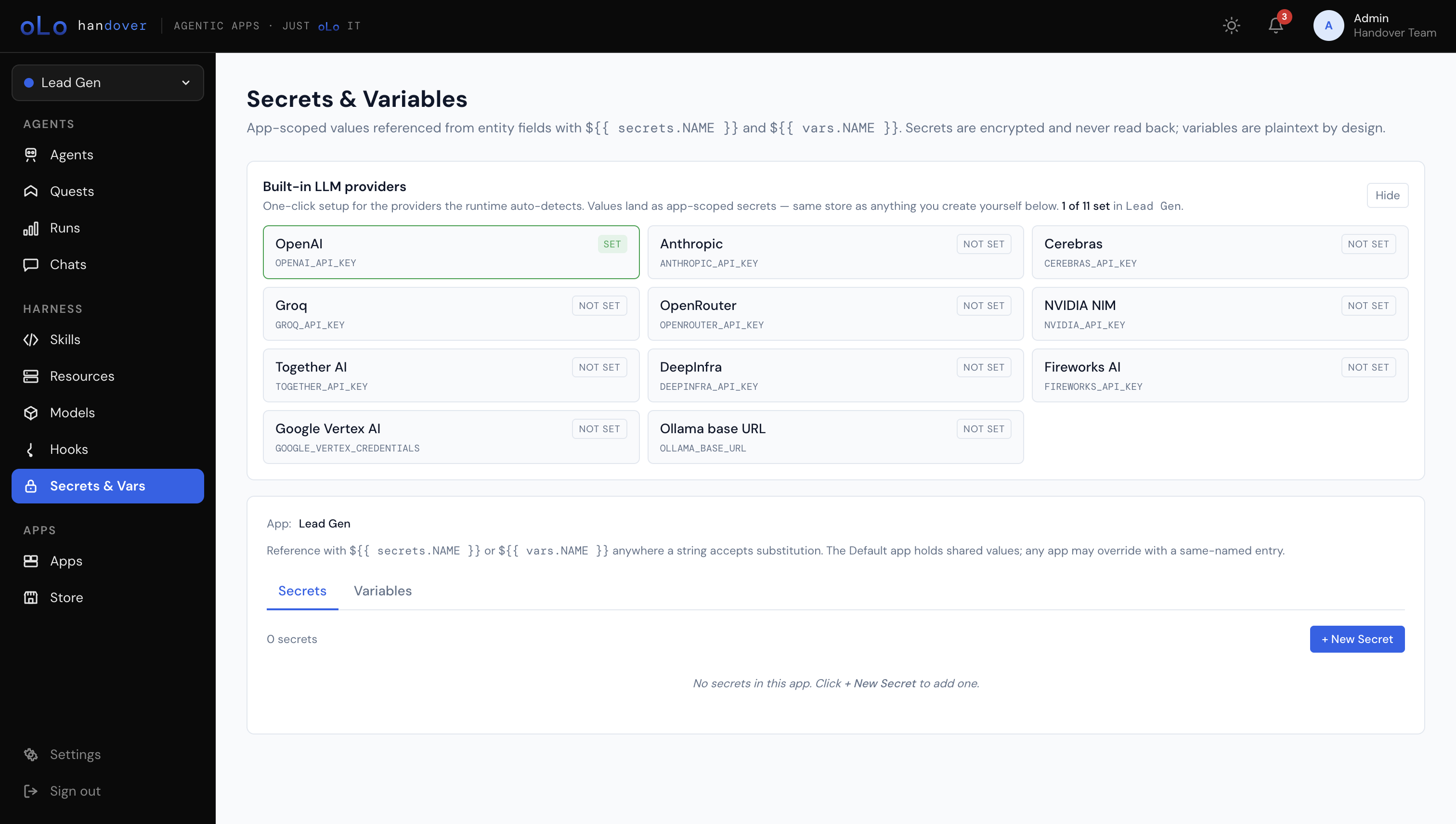
${{ secrets.NAME }} or ${{ vars.NAME }} from any string field. Built-in LLM provider slots, encrypted at rest.Every entity, unit testable.
Tune by hand — or hand it to an agent.
Resources, skills, agents, hooks — every layer has a Test endpoint that runs it in isolation against a mock context. Change one without breaking the others. Sweep the parameter space yourself, or point a tuning agent at it. Production isn’t a black box; it’s a continuous improvement loop with three knobs.
Performance
Lower latency, fewer tool calls, smaller agent loops where they don’t earn their keep.
Cost efficiency
Smaller models for the right skills, fewer tokens per turn, hook batching — without giving up correctness.
Quality
Eval scores, structured-output adherence, agent agreement rate — measured per layer, tuned per layer.
Reference secrets by name.
Audit them by name. Never log the value.
One reference syntax, everywhere
${{ secrets.NAME }} and ${{ vars.NAME }} work in any field that takes a string — resource env vars, MCP server URLs, hook argument templates, custom-model API keys.
At run start, the resolver looks up names in (current app, Default app) with current winning. Secrets are encrypted at rest. Variables are plaintext by design — for things like SENDER_DOMAIN that aren’t secrets.
Audit by name only. Each run emits a single event: this run consumed OPENAI_API_KEY. Names go in the log; values never do, anywhere.
# env_vars
GITHUB_TOKEN: ${{ secrets.GH_TOKEN }}
USER_AGENT: "handover-bot"

# headers
X-Org: ${{ vars.ORG_SLUG }}
Authorization: Bearer ${{ secrets.GH_TOKEN }}
Three things
worth knowing.
MCP-native, all the way down
Every external integration is a Model Context Protocol server. Tools are auto-discovered with typed schemas, no custom adapter code per integration. The MCP ecosystem is your ecosystem.
Multi-tenant from day one
Tenants are the security boundary; nothing leaks across. Secret values are encrypted at rest and never enter logs — only their names appear in audit trails. Designed to scale horizontally so a tenant’s load never affects another’s.
Apps are portable — and shareable
Export an entire app as YAML — agents, skills, resources, hooks, quests, variables, and secret names (never values). Re-import into a different tenant, version it in git, or publish it to the App Store for anyone in your org (or beyond) to install in one click.
One platform.
Every way you run things.
Talk to any agent, multi-turn, durable
Conversations are server-side persistent — close the tab and the session resumes exactly where it left off. Group-chat attribution: each user’s display name rides along on every turn so the agent can tell speakers apart.
Quests execute as runs with live event logs
Layered events stream as the agent works — agent layer, skill layer, resource layer, hook layer. Cancel a run mid-flight, and runs survive process restarts so nothing is lost mid-execution.
Cron-scheduled or directly assigned
A quest declares the skills and resources it needs; the platform routes it to any capable idle agent. Or pin it to one specific agent and skip routing entirely.
Composable lifecycle wrappers
Attach before/after hooks to any entity. Hooks call MCP tools with templated arguments and chain results through a shared context. Auth flows, audit trails, content filtering — all just hooks.
Cross-cutting organization
Tag any entity. Filter list pages, scope YAML exports, build dashboards. Tags stay descriptive — Apps stay structural. Different jobs.
Export your app.
Reimport it anywhere.
YAML in, YAML out
Every entity in an app serializes to a single YAML bundle — the app's tags, resources, skills, agents, hooks, quests, variables (with values), and secrets (by name only).
Re-import into a new tenant or environment. The diff preview tells you exactly what would change before anything commits. Imported secrets land "unfilled" — the operator fills them in once and the app starts working.
Treat apps like packages. Version them in git, ship them between environments, give them to teammates as a starter template.
app:
  name: Lead Generation
  slug: lead-gen

resources:
  - name: Slack
    env_vars:
      SLACK_TOKEN: ${{ secrets.SLACK_TOKEN }}

secrets:  # names only
  - name: SLACK_TOKEN
  - name: OPENAI_API_KEY

variables:
  - name: SENDER_DOMAIN
    value: acme.com
Publish a snapshot.
Install it as a fork.
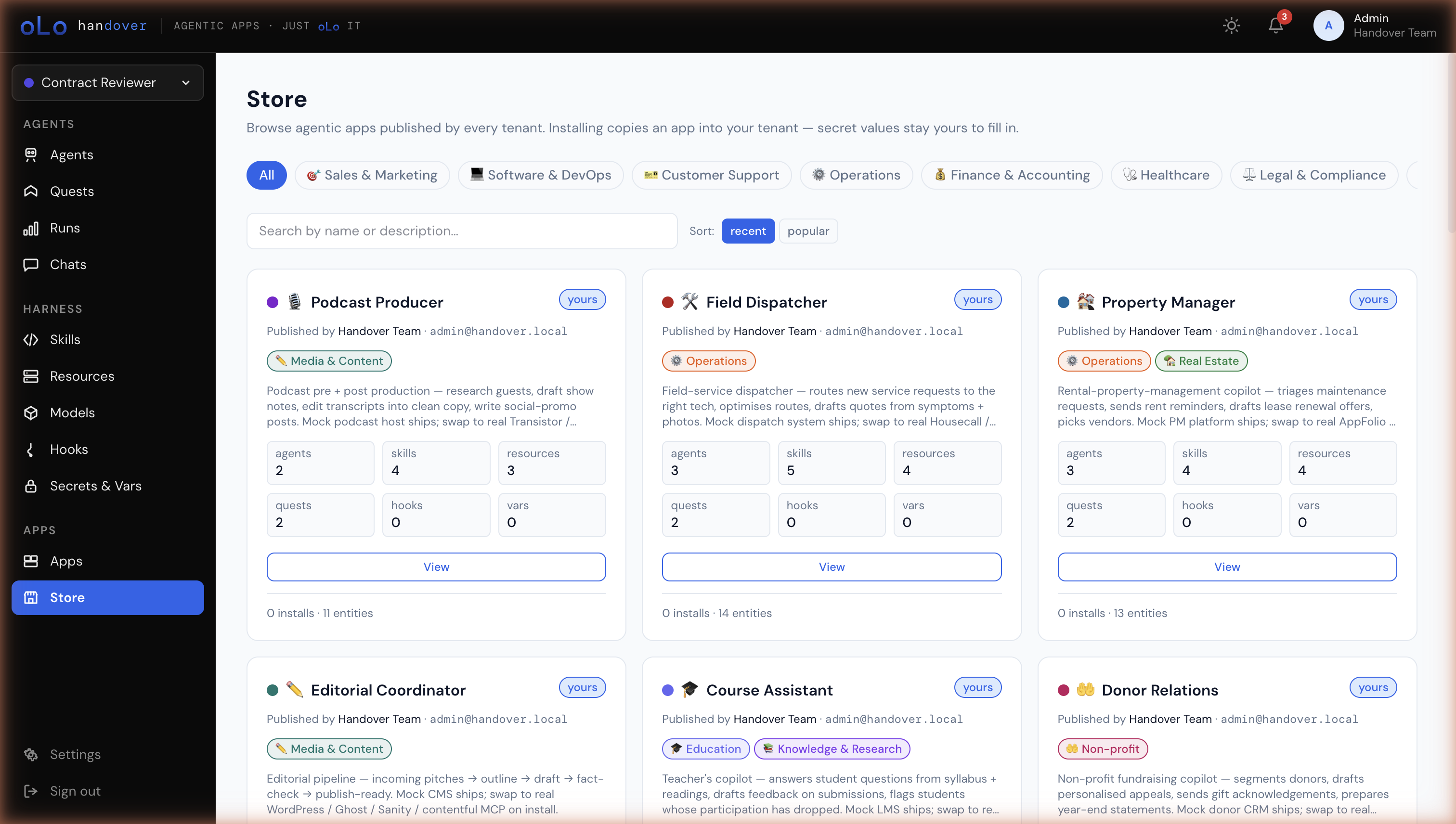
The App Store is a cross-tenant catalog of published apps. Publish bundles a snapshot of your app — YAML and counts and curated category — into a global listing. Install copies that snapshot into the installer’s tenant. There is no live link between publisher and installer; install is a fork.
Publish is a snapshot
Re-publish overwrites the listing’s bundle YAML and counts in place. The listing id is stable; anything linking to it keeps working.
Install is a fork
The installer’s tenant gets its own copy of every entity. Variable values travel; secret values never do — the installer fills those in. Unpublishing later doesn’t touch installed copies.
Mock resources for sensitive industries
Healthcare, legal, and finance apps ship with @handover/mock-* MCP servers that return plausible synthetic data. Installers swap them for real providers in their own tenant.
Active development.
We’d love to hear from you.
Handover is in active development. Tell us about your use case — the agents you want to ship, the resources you’d wire up, the team you’d run it for — and we’ll get back to you.